
10 Things to Do Off the Beaten Track in Rome
Interesting Places in Rome Only Locals Know
There are many things to do off the beaten track in Rome, Italy’s great capital and the heart of Christianity. The city is the cradle of an empire that left a lasting impression on the history and culture of the western world. But behind the postcard views and the more touristy façades of the city, Rome hides a quirky, unusual character, full of fun, secrets, originality, and mystery.
From art to industry, Rome is filled with wonders and surprises. These elements compete to form the Eternal City’s unparalleled atmosphere, constantly suspended between past and present, history and legend. Read on to learn more about the city’s quirky scenes and fun ways to see Rome like a local.
1. Quartiere Coppedè
Discover peculiar architecture in this Rome district

适合: 照片, 经济, 与众不同
Quartiere Coppedè is a district in Rome, between Salaria and Nomentana, where you’re bound to stumble upon imaginative architecture. Named after the architect behind its buildings, the district is a place where Liberty and Art Deco fuse with Gothic, Baroque, and Classical elements – strange juxtapositions typical of eclecticism. Check out the Palazzo del Ragno, aka the Spider Palace, with its Assyrian and Babylonian-inspired shapes, or the asymmetrical Villino delle Fate, aka the House of Fairies.
The whole neighbourhood has an enchanting and mysterious atmosphere, and it’s no coincidence that Dario Argento shot some of his notable film scenes here. We recommend starting with Fontana delle Rane aka Fountain of the Frogs in Piazza Mincio. Music lovers will instantly recognise it as the spot where the Beatles took a dip fully clothed after their epic concert at the Piper Club.
地址: Quartiere Coppedè, 00198 Rome, Italy

Quartiere Coppedè
2. Chiesa di Santa Maria in Vallicella
Home to a miraculous fresco revealed by a hidden mechanism
适合: 历史, 经济, 与众不同
Stroll over to Chiesa di Santa Maria in Vallicella, also known as Chiesa Nuova, to find one among the most ingenious artworks in Rome. Look for an altarpiece created by Rubens in the oval in the middle, behind the main altar. A mechanical system allows it to go up and down, showing or hiding what’s behind.
The artwork in mention is the fresco of Mary, which is especially dear to Christians. In the 1600s the image started to deteriorate, so they protected it with an altarpiece. The mechanism allows the fresco to be temporarily shown to worshippers. Want to see this brilliant artwork and the mechanism in action? Attend evening mass on Saturday or Sunday to see the parish priest operate it.
地址: Via del Governo Vecchio, 134, 00186 Rome, Italy
电话: +39 06 687 5289
Chiesa di Santa Maria in Vallicella
3. Chiesa di Sant’ Ignazio di Loyola
Find the monk-artist’s pictorial illusion
适合: 历史, 照片, 经济
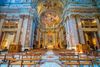
Chiesa di Sant’ Ignazio di Loyola, or the Church of St. Ignatius, is home to a false dome – a normal ceiling that looks like a magnificent dome thanks to an extraordinary optical illusion. The church is just a stone’s throw from Palazzo Chigi. The talented artist behind the illusion was Jesuit monk Andrea Pozzo, who specialised in trompe-l’oeil, a technique used to create such illusory spaces.
Construction of the church began in the 17th century. They ran out of money for the dome during construction, but that didn’t mean they were short of innovation. The artist-monk painted the ceiling to make the building appear higher, with protruding columns and arches. To see the effect at its best, go to the central nave and look for the golden circle showing you where to stand.
地址: Via del Caravita, 8a, 00186 Rome, Italy
开放时间 Monday–Saturday from 7.30 am to 7 pm, Sunday from 9 am to 7 pm
电话: +39 06 679 4406
Chiesa di Sant' Ignazio di Loyola
4. Villa Farnesina
Discover the frescoes by Raphael
适合: 历史, 照片
Villa Farnesina is a must-do in Rome for art lovers as it’s home to lesser-known masterpiece frescoes created by Raphael. The remarkable renaissance villa beside the Tiber, near the Ponte Sisto bridge, was built in the early 16th century by wealthy banker Agostino Chigi. Raphael began work there by frescoing part of the Loggia di Galatea.
Some years later, the owner commissioned him to decorate the ground floor gallery to impress guests during his wedding celebration. This time the maestro didn’t compose isolated scenes, but a cycle of paintings. To fit the occasion, the subject was determined to be Cupid and Psyche. Raphael executed the project and all the characters, but other artists from his studio helped finish the frescoes.
地址: Via della Lungara, 230, 00165 Rome, Italy
开放时间 Monday–Saturday from 9 am to 2 pm (closed on Sundays)
电话: +39 06 6802 7268
Villa Farnesina
5. Santa Cecilia
Rediscover the lost masterpiece by Pietro Cavallini
适合: 历史, 照片
Santa Cecilia is home to a long lost masterpiece in Rome. Mention the Last Judgement, and you’d easily think of Michelangelo’s artwork at the Sistine Chapel. Until the last century, it was thought to be the only one. Then, while renovating the choir in Santa Cecilia, also known as the Benedictine Convent of Saint Cecilia in Travestere, they discovered a masterpiece that had been lost for centuries. It was known as the Giudizio Universale or the Last Judgement, created by Pietro Cavallini who was supposedly Giotto’s tutor.
The fresco dates to the end of the 13th century, 3 centuries before the Sistine Chapel. For its time, it reveals an unprecedented degree of knowledge, artistry and innovation. It’s also appreciated for the figures’ sculptural qualities and expressive faces, the gentle use of chiaroscuro, and attention to detail. Visit the choir to see it, which is open weekdays at specified times.
地址: Piazza di Santa Cecilia, 22, 00153 Rome, Italy
开放时间 Daily from 10 am to 12.30 pm and 4.30 pm to 6.30 pm
电话: +39 06 4549 2739
Santa Cecilia
6. Capuchin Crypt
Enter a chapel of bones
适合: 历史, 照片, 经济, 与众不同
The Capuchin Crypt at the Santa Maria della Concezione dei Cappuccini, or Our Lady of the Conception of the Capuchins, contains the bones of monks. Not many would’ve thought that a stone’s throw from the glamorous dolce vita of Via Veneto there would be such an obscure spot in stark contrast to its surroundings.
Descend to the crypt under a nave, which leads to a 40-metre-long corridor overlooked by 5 chapels. What’s astonishing is how the different bones are used: skulls, femurs and phalanges form a decorative mosaic behind tunicked skeletons. Each room is named after its bones, such as the Cappella delle Tibie or ‘Chapel of Shinbones’ or the one filled with pelvises. Find the message of hope in the last chapel, dedicated to the Resurrection.
地址: Via Vittorio Veneto, 27, 00187 Rome, Italy
开放时间 Daily from 10 am to 7 pm
电话: +39 06 8880 3695
Capuchin Crypt
7. Centrale Montemartini
An old industrial place converted into a museum
适合: 历史, 照片
Centrale Montemartini in Rome is a go-to if you’re into art and history. But the place itself had an unlikely history. Musei Capitolini houses archaeological treasures that are displayed inside the industrial spaces of a former power station in Rome. When the museum’s headquarters needed renovating, they had to find a way to keep the displays visible.
Part of the exhibit was temporarily moved to the Centrale Montemartini after its spaces were salvaged in an industrial archaeology operation. Setting the artefacts in a contemporary ‘archaeological dig’ was so successful it stayed long after. For a sight of stark contrasts, see the brilliant second exhibition area of machines, valves and pressure gauges that provide the backdrop for busts and sculpted marble, all for an unusual yet spot-on effect. To get there, catch a bus from Via Ostiense or a take a short walk from Garbatella station. 阅读更多内容
地址: Via Ostiense, 106, 00154 Rome, Italy
开放时间 Tuesday–Sunday from 9 am to 7 pm (closed on Mondays)
电话: +39 06 0608
Centrale Montemartini
8. The ‘Little London’ of Flaminio
A Notting Hill-like neighbourhood in Rome
适合: 照片, 经济, 与众不同
Flaminio is home to one of the well-known roads in Rome that’s anything but Roman since the houses, gardens and entranceways are perfectly English. Enter via Celentano, nicknamed Piccola Londra or ‘Little London’ thanks to its British touches in the heart of the Eternal City. The road in the Flaminio neighbourhood has large buildings obscuring the walkway, so you might easily miss it.
Away from the madness of the city, it feels like a miniature reproduction of Notting Hill. The brains behind this gem were mayor Ernesto Nathan and architect Quadrio Pirani. They dreamed of a modern, cosmopolitan city that measured up to the great European capitals, giving rise to this original experiment. From then on, Flaminio embraced its English liking.
地址: Via Bernardo Celentano, 00196 Rome, Italy
The ‘Little London’ of Flaminio
9. Musei di Villa Torlonia
Admire the magnificent Liberty architecture
适合: 历史, 照片
Among the good reasons to visit Villa Torlonia and the Casina delle Civette or House of Owls are its architecture and unique interiors. What used to be a rustic building with shapes inspired by a swiss lodge, was transformed into a splendid example of Art Nouveau after a set of revamps, additions and alterations. Secondly, its furniture, etchings, statues, plaster and majolica with flora and fauna-inspired forms and figures are sights to behold.
The masterfully crafted windows create a fairy-tale atmosphere. You’ll notice a recurring theme of owls, hence the house’s name. The cottage was built by Prince Alessandro Torlonia as a leisure spot, but his nephew Giovanni is credited for its current aesthetic. Given his love for esoteric symbolism, almost every decoration features owls.
地址: Via Nomentana, 70, 00161 Rome, Italy
开放时间 Tuesday–Sunday from 9 am to 7 pm (closed on Mondays)
电话: +39 06 0608
Musei di Villa Torlonia
10. Jasmine Walk
A charming promenade near the Vatican
适合: 照片, 经济
Take the Jasmine Walk in Rome if you want to see Michelangelo’s dome from an unusual perspective as well as take some unique photo angles. Head to San Pietro station but don’t catch the train. Go in and immediately turn right. Continue along platform 1 then enter the Passeggiata del Gelsomino or Jasmine Walk.
This 1 km walk leads to a staircase along the Vatican walls, the Rampa Aurelia. The walk follows the tracks of an old railway connection between Italy and Vatican City. Once a notable route used by the Pope, it became obsolete with the emergence of new modes of transport. The platform was therefore decommissioned and turned into a footpath. Look left and you’ll see functioning freight rails, while the right opens to a gorgeous view of the Basilica.
地址: 00100 Rome, Italy
Jasmine Walk
本文包含 Go Guides 编辑团队的意见。Hotels.com 好订网对作者出现在本网站上的文章给予补偿;此类补偿可能包括差旅费和其他费用。